
Zimbabwe's Data for Action on Food Fortification Workshop
Zimbabwe advances a data-driven agenda for large-scale food fortification
National stakeholders reviewed the country’s fortification data sources, agreed on the need for a national data platform and shared governance protocols, and identified priority actions to strengthen laboratory, survey and compliance monitoring systems.
Workshop details
Event: From Data to Action: Strengthening Large Scale (LSFF) Food Fortification Decision-Making in Zimbabwe
Date and location: 9 July 2026 | Online
Participation: 27 participants representing government institutions, standards and regulatory bodies, food industry, laboratories, development partners, regional organizations, academia and civil society.
Building a stronger foundation for LSFF data use
Large-scale food fortification (LSFF) is a proven, cost-effective way to reduce micronutrient deficiencies, but its impact depends on timely, high-quality data that decision-makers can use. As a follow-up to the October 2025 Africa Regional Dialogue on Data for Action in Food Fortification, the Food and Nutrition Council (FNC) and the Ministry of Health and Child Care (MoHCC) convened a virtual workshop, in partnership with the East, Central and Southern Africa Health Community (ECSA-HC) and the Southern African Development Community (SADC) under the Eastern and Southern Africa Regional Coordination Mechanism on Food Fortification (ESA RCM), with support from DInA. The workshop focused on strengthening how fortification data are generated, managed, shared, analyzed, and used in Zimbabwe.
Participants reviewed the national data sources that already support fortification decisions. These include the Zimbabwe Livelihoods Assessment Committee (ZimLAC) assessments, ZIMSTAT surveys, the Zimbabwe Demographic and Health Survey, DHIS2, government laboratory records, food balance sheets, industry reports and market surveillance data. Regional experiences with national dashboards, integrated data platforms and routine multi-stakeholder review offered practical models for Zimbabwe to adapt.
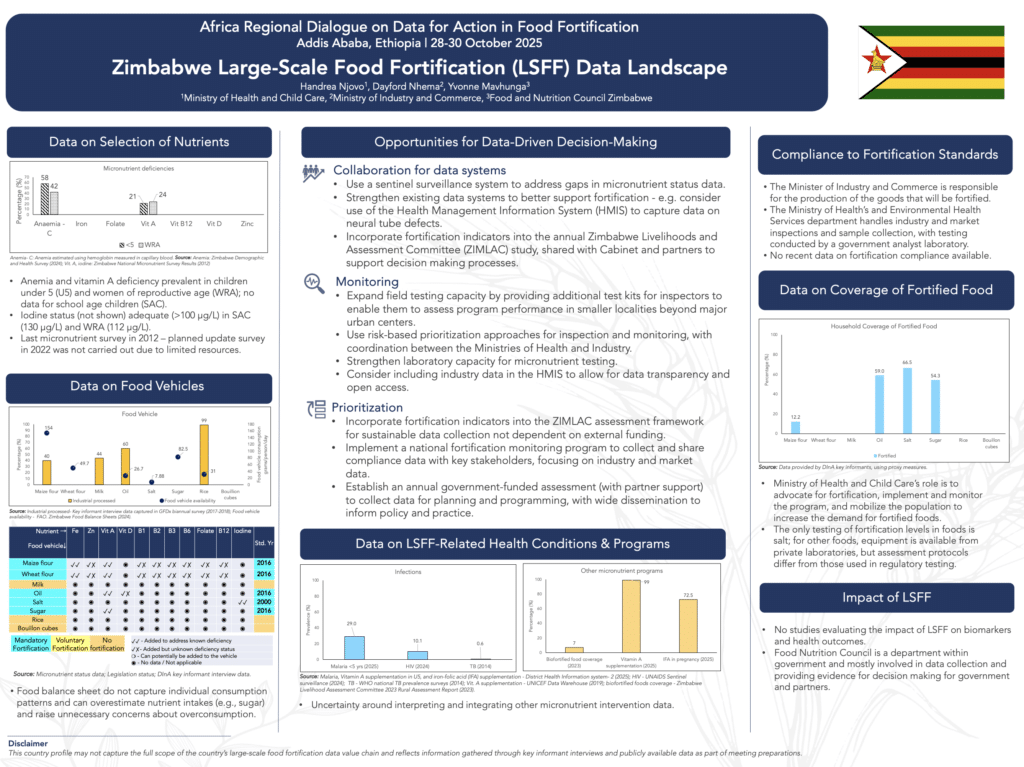
Prior to the October 2025 Africa Regional Dialogue on Data for Action in Food Fortification, country delegates from Zimbabwe created this LSFF data landscape, with information on: the available and accessible national level LSFF- related data, who owns the data, how data are shared and used, and country-specific opportunities for filling data gaps.
Workshop achievements and identified LSFF-focused data priorities
The webinar confirmed that a substantial amount of fortification-related information already exists in Zimbabwe. However, it is fragmented across institutions, which limits its value for decision-making. Several gaps continue to constrain the program:
- limited interoperability between data systems.
- incomplete and inconsistent reporting.
- shortages of laboratory equipment, reagents, trained staff and accreditation.
- limited routine data on consumption, coverage and geographic disparities.
- outdated micronutrient status information, with the last national micronutrient survey conducted in 2012.
Participants reached consensus on the need for a government-led national fortification data platform. They endorsed the national food fortification coordination platform as the main mechanism for reviewing data and making decisions. They also agreed that existing national systems should be used more effectively rather than replaced with new structures. Priority actions, with responsible institutions, timelines and funding pathways, will be integrated into the ESA RCM workplan and tracked through regular coordination meetings, dashboard reporting and annual workplan reviews.
Five priorities for focused implementation
Establish a government-led national fortification data platform, led by FNC and MoHCC with ZIMSTAT and development partners, with phased implementation over 12 to 24 months.
Develop national data governance and sharing protocols that set out how government, regulators and industry share and use fortification data.
Map and harmonize existing data systems and indicators, and integrate fortification indicators into national surveys and surveillance systems.
Strengthen laboratory capacity for micronutrient testing and digitalize laboratory, inspection and industry reporting to improve compliance and coverage monitoring.
Translate data into dashboards and evidence briefs for decision-makers, and mobilize domestic and partner financing to sustain data systems, surveillance and research.
