
Malawi's Data for Action on Food Fortification Workshop

Malawi advances a data-driven agenda for large-scale food fortification
National stakeholders identified priority data gaps, agreed on coordinated action, and launched new guidelines and monitoring indicators to strengthen food fortification.
Workshop details
Event: From Data to Action: Strengthening Large Scale (LSFF) Food Fortification Decision-Making in Malawi
Date and location: 20 August 2026 | Online
Participation: 33 participants representing government institutions, development partners, civil society organizations, academia and other stakeholders.
Building a stronger foundation for action
Large-scale food fortification (LSFF) is a proven, cost-effective way to reduce micronutrient deficiencies, but its impact depends on timely, high-quality data that decision-makers can use. As a follow-up to the October 2025 Africa Regional Dialogue on Data for Action in Food Fortification, the Malawi Ministry of Health, through the Department of Nutrition, in partnership with the Eastern, Central and Southern Africa Health Community (ECSA-HC) under the Eastern & Southern Africa Regional Coordinating Mechanism on Food Fortification (ESA RCM), with support from DInA, convened a virtual workshop focused on formalizing an implementation plan to strengthen Malawi’s LSFF data ecosystem.
The meeting provided an opportunity to share lessons from the regional dialogue Addis Ababa and to consider how these lessons could be translated into a practical and coordinated plan. The discussions focused particularly on the availability, quality, ownership, integration and use of fortification data for program monitoring, enforcement, and decision-making.
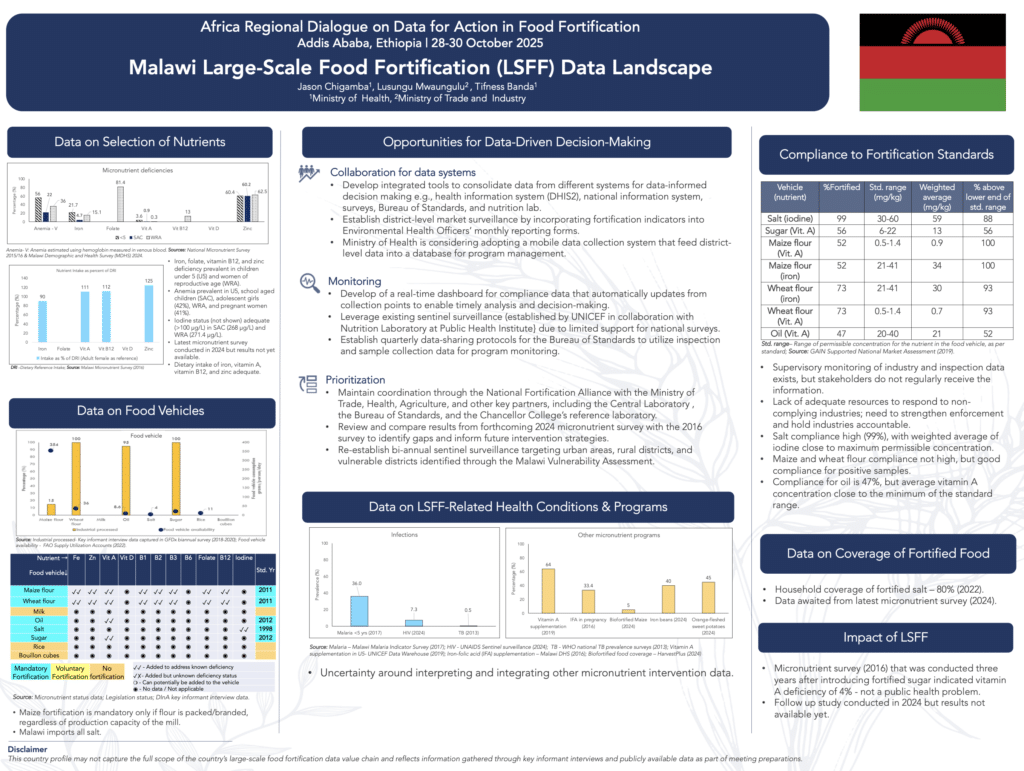
Prior to the October 2025 Africa Regional Dialogue on Data for Action in Food Fortification, country delegates from Malawi created this LSFF data landscape, with information on: the available and accessible national level LSFF- related data, who owns the data, how data are shared and used, and country-specific opportunities for filling data gaps.
Workshop achievements and identified LSFF-focused data priorities
The webinar reaffirmed that Malawi has important foundations for an effective LSFF programme, including established standards, government monitoring structures, laboratory capacity, private-sector engagement and experience in data consolidation. However, fragmented data systems, unclear responsibilities, limited resources and weak integration continue to constrain effective use of LSFF information.
Strengthening the data ecosystem will require clear institutional roles, harmonized indicators, improved routine monitoring and laboratory linkages, stronger district and industry engagement, timely survey results, and sustainable financing.
The proposed approach would focus on the five priority areas described below. Within these five areas, the Ministry of Health, Department of Nutrition presented comprehensive ten-point implementation plan. The draft plan is expected to be revised to incorporate comments raised during the webinar before being circulated to wider National Technical Working Group for formal adoption.
Five priorities for focused implementation
Map and harmonize existing data and tools, including common indicators, reporting formats, and data definitions.
Clarify institutional roles for data collection, ownership, validation, sharing, and use.
Strengthen data quality and digitization, including routine quality checks and development of a central LSFF database or dashboard.
Integrate laboratory, inspection, and industry quality-control data to improve monitoring of compliance and follow-up of non-compliance.
Link compliance data with coverage, consumption and nutrition outcomes to better assess the performance and impact of fortification interventions.
